

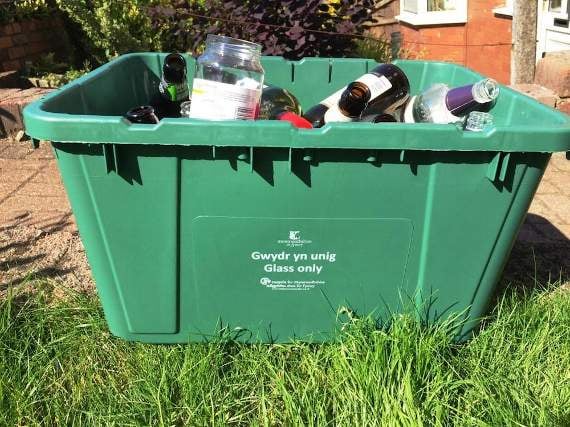
MONMOUTHSHIRE County Council (MCC) is carrying out its biggest review of waste collection and recycling in more than a decade.
One major change next March will be to collection rounds, with the introduction of 20 new lorries which will separate pink and purple bags, garden and food waste bags.
The war on single-use plastics is also being accelerated through a Welsh Government-funded scheme in which Key Stage One pupils, who previously drank their milk from small plastic cartons, will in future have it decanted into reusable beakers from glass bottles. MCC has recently awarded its contract to Raglan Dairy and milk for all Key Stage One schoolchildren will be delivered in glass bottles to be collected after use, sterilised and re-used. The dairy sources all its milk from within 30 miles of its base in Raglan.
School milk has been delivered in third-pint plastic bottles for a number of years and in Monmouthshire this amounts to 11,500 bottles a week, or a whopping 437,000 every year.



The processing of the county’s food waste is also going to change.
Currently food waste goes into corn starch bags for ‘in vessel composting’ in Gloucestershire but a new contract, starting in December, uses a new anaerobic digester in Bridgend which will generate electricity as well as producing compost. The company wants this waste collected in plastic bags.
Carl Touhig, MCC’s head of waste and street services, admits that seems like ‘a retrograde step’ - but it will save the council money and, rather than supplying households with additional single-use plastic bags, he is keen to encourage people to use discarded plastic food bags from their fridges and freezers.
Wales is the third best recycler in the world (at 64 per cent) and MCC is joint second best recycling county in Wales (at 69 per cent).
Nowadays none of the county’s black bag household rubbish is sent to landfill. Instead it is processed in an ‘energy from waste’ facility in Cardiff, generating enough electricity to power 50,000 households. A magnet even removes metals from the ash for recycling, with the ash used to make aggregate and building blocks.
But the aim is to do even more, particularly when it comes to single-use plastics.
“Plastic is part of our lives, a product with many good uses - but single-use plastic is simply not needed and there’s been a major shift in public opinion in the light of David Attenborough’s Blue Planet II series,” says Mr Touhig.
“The tide seems to be turning. More has been achieved off the back of that series than anything I’ve seen in 15 years.
“But it’s not just about reducing the number of plastic bags in the oceans. We need to reduce the use of all unnecessary packaging including wood and paper.”
Mr Touhig appreciates that people are very confused about what can and can’t be recycled.
“Black plastics like food trays are difficult because the sorting system has an optical recognition system and it cannot recognise black.
“Similarly at the moment we can’t recycle crisp packets and cling film. But things are changing all the time and we can deal with most food packaging - so the message is please put all your plastic waste in the purple bags and let us sort it out.”
Mr Touhig thinks it requires action at Government level to curb the use of black food trays ‘simply to make meat look more appealing’ and he also supports the idea of introducing deposits on plastic bottles.
He is also keen for more people to complete a survey which is collecting feedback on a wide range of waste collection and recycling issues.
The consultation, which has received 1,700 responses, showed that a majority supported the idea of replacing pink and purple bags with reusable containers – a system trialled in Abergavenny.
The link can be found at www.monmouthshire.gov.uk/recycling-and-waste
Comments
This article has no comments yet. Be the first to leave a comment.