

Heading to the Eisteddfod today and not sure what to expect? Here’s all you need to know about the main event this afternoon.
Mid-way through this week-long celebration of arts and culture, the National Eisteddfod will honour its writers today, with the Prose Medal Ceremony held at 4.30pm.
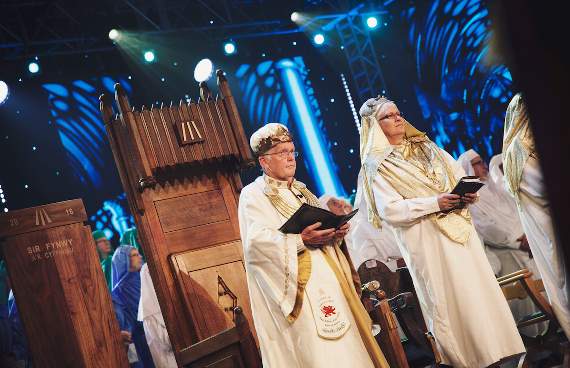
The traditional Gorsedd ceremony will be led by the Archdruid, the presiding official of the Gorsedd, on the Pavilion stage. This is the second Gorsedd ceremony of the week, the others are the Crowning on Monday and the Chairing to come on Friday.
The Gorsedd of Bards is an association of poets, writers, musicians, artists and honorary members who conduct ritual druid ceremonies to celebrate the celtic arts and the achievements of its members.




The ceremony today provides a great deal of the pageantry that is associated with the National Eisteddfod. Honorary members dress in blue robes, members of the arts dress in green robes and competition winners wear white robes.
The Gorsedd, although appearing to be an ancient order, is only just over 200 years old. It was the product of the imagination of 18th century poet and antiquary Iolo Morganwg. He devised a ceremony in the year 1792 in order to elevate the art of poetry and literature, because he believed that the Welsh nation had always given prominence to poetry and music.
The very first Gorsedd ceremony was held by Iolo on Primrose Hill in London, and in order to give the appearance of greater antiquity, he devised an imaginary druidical setting for his ceremony.
The ceremony begins when the Herald Horns sound and the audience stand. The judges are then invited to the stage and one delivers the adjudication, outlining the competition and the standard of entries.
Each entrant for today’s prose competition enters using a pseudonym, so the competition is judged anonymously. The competitors place their name and contact details in a sealed envelope and this envelope is sent to the Eisteddfod office. Once the adjudication process is completed, the sealed envelope with the winner’s details is opened, and the rest of the envelopes remain sealed and are sent to the National Library of Wales and stored in the Eisteddfod archive. The identity of the winner remains a well-guarded secret, and the potential identity of the winner is a talking point across the Maes throughout the day.
At the end of the adjudication, we find out whether there is a winner. The Archdruid calls the pseudonym and invites him/ her to stand. The lights in the auditorium are dimmed, the Herald Horns sound to all four directions of the compass and the winner, sitting somewhere within the 2,500 seat pavilion, then stands. A searchlight scours the audience looking for the winner, and she/ he is then escorted to the stage by the Gorsedd. And Wales’ best kept secret is revealed as the name of the winner is announced by the Archruid.
When the Archdruid reveals the identity of the winning writer, the Herald Horns calls the people together and the Gorsedd Prayer is chanted. The Archdruid withdraws a sword from its sheath three times. She cries ’A oes Heddwch? (Is there peace?)’, to which the assembly reply ’Heddwch. (Peace)’. The sword is then placed fully back into its sheath, and hence is never drawn fully. Then the Corn Hirlas (Horn of Plenty) is presented to the Archdruid by a young local married woman, who urges her to drink the ’wine of welcome’.
A young girl presents her with a basket of ’flowers from the land and soil of Wales’. Local children perform a floral dance, based on a pattern of flower gathering from the fields. The Archdruid brings the procession to a close with the Welsh National Anthem.
Occasionally, the adjudicators of the main competitions decide that there is no-one worthy of the national prize. To demonstrate that the prize is withheld the Herald Bard and the Grand Sword Bearer place the Grand Sword across the arms of the empty chair where the winning poet or author would have sat.
Comments
This article has no comments yet. Be the first to leave a comment.