

STORING Britain’s nuclear waste in disused Forest of Dean coal mines was under serious consideration during the 1950s, it has been revealed.
After the first years of the UK’s atomic energy and weapons programme, plans were initially approved to dump radioactive waste in some of the district’s old pits.
Harwell, established in 1946 in Oxfordshire, was the birthplace of the UK nuclear industry and served as Britain's first Atomic Energy Research Establishment.
It housed 14 experimental reactors to advance nuclear energy, and is currently undergoing major decommissioning to clean up nuclear facilities and remediate land for the Harwell Science and Innovation Campus.



Back in the 1950s the site was relatively new and authorisation had already been given for the dumping of radioactive waste from Harwell and Aldermarston in disused collieries in the Forest of Dean and Berkshire.
The Dean Forest Mercury reported on August 20, 1954, that these included New Fancy near Parkend, and Crump Meadow, Foxes Bridge and Lightmoor near Cinderford,
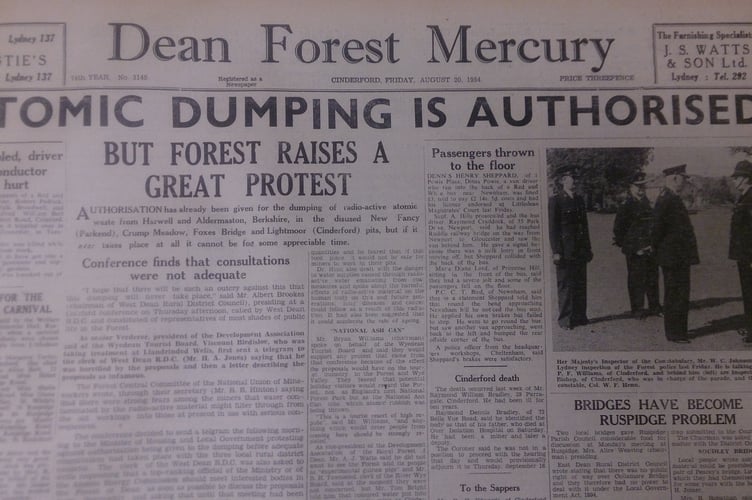
But the plans, which would ultimately be dropped, sparked strong protests in the Forest and concern over inadequate consultations over the proposals.
“I hope that there will be such an outcry against this that this dumping will never take place,” Albert Brookes, then chairman of the now abolished West Dean Rural District Council, said at the time.
There were strong fears among miners that water contaminated by radioactive waste might filter through from the old workings into mines which were still in use at the time.
A special conference of the three rural district councils, convened in Coleford to discuss the plans, decided to write to the Minister of Housing and Local Government protesting against the authorisation being given.
Government geologists claimed at the time they were satisfied that no contamination of water supplies could take place in the Forest of Dean.
But Lord Bledisloe was quoted at the time sas aying that, in his long life, he had never heard of any scheme so calculated to damage this beautiful, health-giving area.
He suggested that there was insufficient knowledge as to the noxious effect of radioactive waste materials.
Morgan Philips Price, then MP for West Gloucestershire, also thought the miners were entitled to be afraid of the result of depositing radioactive waste in the Dean.
“There is probably a feeling among Government officers that the Forest of Dean is a derelict mining area and it does not matter what is put into its old pits,” he said.
“That is complete nonsense.”
He called for assurances that the storage of nuclear waste would be no detriment to the population of the Forest and the tourism industry.
“We have a right to more information and we have a right to expect that the three district councils shall be adequately consulted,” he said.
“We must not have this thing foisted upon us without getting much greater assurance than we have now.”
And the proposals to store atomic waste in the Forest of Dean were ultimately – and thankfully – dropped.
Comments
This article has no comments yet. Be the first to leave a comment.