
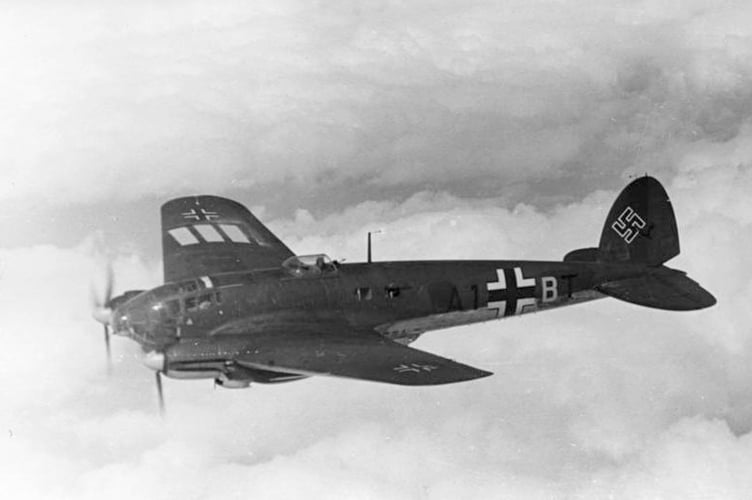
THIS interesting letter about the WWII bombing of a train by a German plane near Chepstow on November 9, 1940, was written to sister paper The Forest and Wye Valley Review by the late Nobby Tyrrell of Tintern sometime in the late 1980s or 1990s.
It was found by his daughter, Dawn Quelch of Caldicot, during a recent house move and she passed it to us.
“Having read your report in the Review, complete with picture of the gentleman who received the George Medal (Frederick Dainty Cox, of the bombing of a train between Woolaston and Beachley, I can tell you (perhaps for the benefit of the younger generation) what really happened that day.
“It was on a Saturday morning around midday, my father (the late Harry Tyrrell of Tidenham Chase) was the ganger in charge of that stretch of railway track.




“In those days they worked on a Saturday until 12 o’clock. Having set his gang to do whatever their work was that morning, he set off on his journey to walk the track, up and back down, to check everything was in working order – a job that was his every day, including Sundays.
“He arrived back at their little hut (used for bad weather and to have their meal in comfort) a bit late to find all his men had gone home with the exception of one, a Mr Fred Ball also of Tidenham Chase, who he walked to and from work together with for years.
“They were just about to leave themselves when an express train went through heading for Gloucester, when down came this German bomber and tried to bomb it.
“Fortunately it missed the train but some bombs exploded on the side of the track, blowing down the telephone communication wires.
“Two bombs fell in what they call the ‘10-foot’ (that’s the piece of road that separates the ‘up’ track from the ‘down’ track) and failed to explode.
“My father and Fred Ball ran (one up, the other down) a fair distance of track and laid detonators on the line (which explode a loud bang, a warning) as soon as the engine passes over them to stop all trains before reaching where the unexploded bombs were.
“Then, without seeing what dangers were involved, although my father was a First World War veteran, they started digging with picks and shovels, retrieved the bombs, carried them down the embankment, across a distance of river wharf and laid them down in the mud on the bank of the River Severn, later to be blown up by the army disposal men.
“Mr X, who received the George Medal, was a telephone engineer from Gloucester who came down as soon as possible and repaired the telephone wires.
“My father and Fred Ball were in the Home Guard at that time at Tidenham.
“Their platoon commander was a man of means, who lived in Boughspring House, Tidenham, a Major Barnsley.
“For their bravery (and I think out of the Major’s own pocket) the whole platoon was given a dinner at the Feathers Hotel, Lydney where my father and Mr Ball were guests of honour.
“My father told me this story many times.
“He was a modest man and never expected anything, but as you listened to him, you got the feeling that somewhere, deep down inside, if there was a decoration to be given for that job, I think he thought that him and his mate should have been included.
– Nobby Tyrrell, Tintern.”
The announcement of the George Medal award in the London Gazette, dated March 28, 1941, stated: “Frederick Dainty Cox, Telegraph Lineman's Assistant, Great Western Railway.
“Immediately after an enemy air raid, it was found that railway communications had been broken.
“Cox and another railwayman were sent to examine the line and discovered that one bomb had exploded and broken several telegraph wires, while an unexploded time bomb had fallen on the permanent way.
“After repairing the most important of the damaged telegraph circuits, Cox carried the bomb to the down side of the line and dropped it over the boundary hedge on to soft ground. This enabled a single line to be put into operation.
“Although warned by the police to stop work, as another time bomb had been dropped nearby, both men continued until the repairs to the wires had been completed.
“Cox then searched for and found the second bomb and helped the Bomb Disposal staff to move it to a place of safety.”
Comments
This article has no comments yet. Be the first to leave a comment.