

Once again Rotary Monmouth in collaboration with Chepstow and Ross on Wye Rotary clubs are organising Walk The Wye on September 27 in support of cancer research carried out at Velindre Cancer Centre in Cardiff.
Thousands of people up and down the country have benefited from cancer research at Velindre, which develops new therapies and treatments, especially for breast cancer.
Women and men who have benefited from the work at Velindre, supported by Rotary Monmouth, were asked to come forward and share their experiences with our readers.
Almost everybody knows somebody who has been affected by cancer either directly or through people they know.


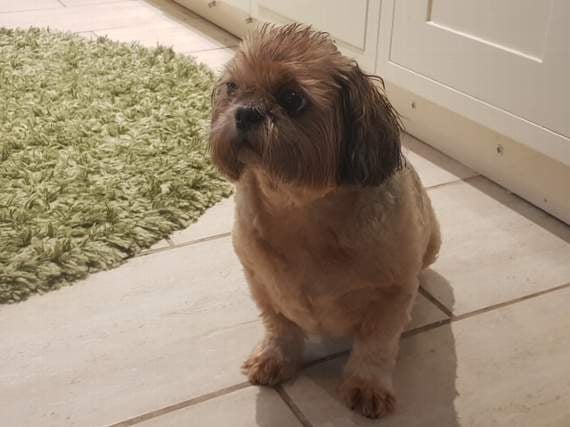
Here is the the story of how one woman’s fluffy bundle of love, Molly, changed the course of her owner’s life for ever – and how you can celebrate with them and help Velindre Cancer Care by joining Rotary Monmouth’s Walk The Wye.
Debbie was looking forward to a relaxing day, celebrating her 48th birthday with family and friends.
She stretched, luxuriating in the comfort of her bed, and waited for the usual morning greeting from her little dog, Molly, who always climbed onto the bed to give her beloved mistress a morning kiss on the face.
At that point, however, her day started to go wrong.
Molly came onto the bed as usual, but instead of her ritually enthusiastic face-lick the little dog just stood on Debbie’s chest, looking at her and moving her foot on her breast, which felt a little uncomfortable.
Molly’s strange behaviour disturbed Debbie.
As she pondered its cause in her morning shower she realised she could feel a lump in her breast, where Molly had been pressing.
Discomfited by the strangeness of the coincidence, she decided to take herself to her GP ‘just to check’.
The doctor reassured Debbie that it was very unlikely to be anything other than a benign cyst - something most women are only too familiar with - but just to be on the safe side he sent her for a mammogram and an ultrasound.
You can imagine Debbie’s shock when she was told that her small ‘cyst’ was in fact a cancerous tumour, 2cm large, and even worse that it was a particularly aggressive form of breast cancer.
And so the nightmare began. Once she was over the initial shock, Debbie’s immediate worry was for her two boys: how was she going to tell them their mother was dangerously ill, what was she going to tell them - about her treatment, its effects, her chances of survival? That was when she turned to Velindre and all the support it could give her.
Debbie, naturally, was dreading the whole package: surgery, chemotherapy, losing her hair, the sickness and loss of energy - until, with the help of Velindre staff, she came to terms with it and realised that chemotherapy, in particular, was not going to kill her.
The way she described the support she received from Velindre was as follows:
‘‘They made me feel safe, that I knew what to expect and they were there for me. It was like I had a big arm wrapped around me. The hospital gave me hope and a feeling of safety, and everyone there encourages you.’’
Velindre’s care doesn’t end with treatment and dealing with its immediate after-effects, and it has continued to support Debbie in her recovery and beyond.
As Debbie says: ‘‘It’s challenging, for me the memory of my illness never leaves me and I am now like a new me, my old self is gone.’’
She describes with calm conviction how precious life is to her.
‘‘I don’t get wound up about small things, I don’t look to the future, I don’t book things in advance, I live day by day and don’t allow any negatives to spoil things, I don’t cry, and I make sure to make the most of every day.
‘‘This experience has made me closer to the people around me, and appreciate how much they can help - for example, I had to go to Cardiff to get a wig when my hair fell out.
‘‘I was dreading the whole experience, but my hairdresser volunteered to come with me and she made it a really special and successful day out, and has since become one of my closest friends.’’
Hugely grateful for how Velindre helped her get through the whole experience, Debbie now volunteers for them on a regular basis.
However, as she says: ‘‘The aftercare at Velindre needs more money.
‘‘When you finish treatment Velindre can offer occupational therapy, reflexology, a dietitian, help with welfare rights and group sessions with others who, simply, ‘get’ what you’ve been through.’ All this is vital to many of those who have been through a traumatic experience, and helps both them and their families make a full return to ‘normal’ life.
As Debbie says: ‘‘When I was first diagnosed I went into ‘protection mode’ for my sons. In their turn, Velindre were there to protect me.’’
It is significant that research is being carried out into how reliable dogs can be at detecting cancer, and it is almost certain that soon they will become ‘man’s best friend’ in yet another way by detecting certain cancers even before standard medical tests can make a firm diagnosis (see MedicalNewsToday - Medical detection dogs: how they could save our lives in a sniff).
For Debbie, there is no question of how very special her best friend Molly is, trained or not: ‘‘Put quite simply, Molly saved my life.’’
To find out more about the work of Velindre, visit their website: www.velindrecc.wales.nhs.uk. To help raise funds, why not join Rotary Monmouth’s Walk The Wye on September 27.
For more information and to find out how you can join in with raising funds, see www.walkthewye.com or www.monmouthrotaryclub.com.
Comments
This article has no comments yet. Be the first to leave a comment.