

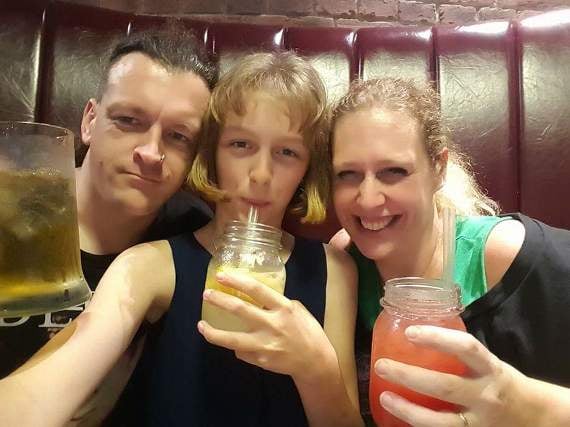
A DETERMINED volunteer is on the road to recovery after a life threatening infection left him on life support.
Luke Dobson, who together with his wife Julie is part of the ‘core team’ of volunteers with Rogiet Parkrun, was diagnosed with sepsis after feeling unwell earlier this month, but was eventually told he had necrotising fasciitis, sometimes called the ‘flesh-eating disease’: a rare but serious bacterial infection that affects the tissue beneath the skin.
After he missed work and was “a bit off colour” the previous day, Luke’s condition got worse and worse and around 12pm on Saturday (6th January) an old wound on his elbow, approximately the size of a 5p coin, appeared to have become infected.
As the day passed his condition worsened and, after attempting to contact an out-of-hours GP, Luke was taken to the Royal Gwent Hospital’s A&E department at around 10pm.


By this time the earlier swelling had extended to between Luke’s knuckles and his shoulder.
“It got more and more serious as the night went on,” said Julie, a mental health nurse.
When he went into septic shock, which has around a 50 per cent mortality rate, Julie said “the odds were not great at that point”.
After a busy night, with at one point six consultants surrounding his bed, at 9am Luke went into the first of four surgeries to remove the affected tissue. These operations involved flesh being removed from his wrist to his bicep. In total Luke was in intensive care for eight days, and on life support for three days.
Fortunately for Luke’s recovery, it was not necessary to remove muscle tissue as part of the operations. He has already begun some physiological treatment as part of his recovery.
He is now awaiting transfer to Swansea’s Morriston hospital, which it is hoped will take place this week. He will then undergo a number of plastic surgery treatments on his arm.
According to NHS Choices, necrotising fasciitis is a rare but serious bacterial infection that affects the tissue beneath the skin, and surrounding muscles and organs.
It’s sometimes called the ‘flesh-eating disease’, although the bacteria that cause it don’t ‘eat’ flesh but release toxins that damage nearby tissue.
Necrotising fasciitis can start from a relatively minor injury, such as a small cut, but gets worse very quickly and can be life threatening if it’s not recognised and treated early on.
Even with treatment, it is estimated that one or two in every five cases are fatal.
With Luke now out of intensive care, Julie has described his condition as “definitely more positive”.
“He’s made an amazing recovery considering 10 days ago he was close to death,” she said.
Julie believes one of the reasons for Luke’s promising recovery is to do with his strength and determination.
“He is so determined,” she said.
“As soon they they took a tube out of his mouth, he was asking: “what do I need to do to get out of here?”
“He has come to the point where he’s stable and eating; we’re waiting for a bed at Morriston where he’ll be for a few weeks.”
Doctors believe the issue came from complications with a chest infection and an invasive Strep A infection on Luke’s elbow.
News of Luke’s condition prompted widespread support, with a number of people writing their support on social media to wish him a speedy recovery.
Event director for Rogiet Parkrun Catherine Baker wrote on Facebook: “Luke, we all look forward to seeing you back at parkrun when you’re better and you’re ready. In the meantime we are all thinking of you.”
Julie will be running the Severn Bridge 10k in August for the UK Sepsis Trust, and has already raised £375 out of her £1,000 target. She hopes to raise awareness for a condition which, according to the charity, accounts for 44,000 deaths annually in the UK: more than breast cancer, bowel cancer and prostate cancer put together.
To donate to Julie’s fundraising appeal visit www.justgiving.com/fundraising/julie-dobson15
Comments
This article has no comments yet. Be the first to leave a comment.