

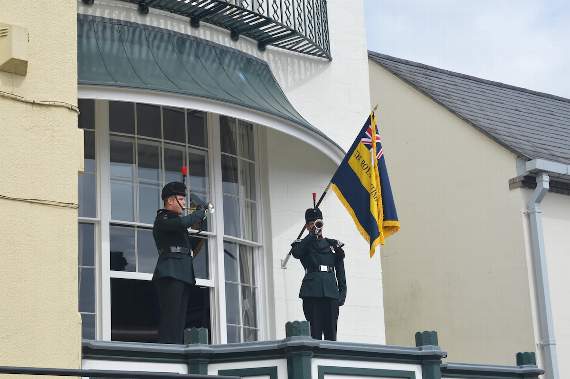
THE Chepstow community gathered on Friday (1st July) to pay their respects to the soldiers who served in the Battle of the Somme on the 100th anniversary of the infamous offensive.
On 1st July 1916, the allied forces launched their ill fated attack on the German lines and suffered devastating losses with the British forces taking 57,470 casualties, 19,240 of which were deaths.
Dozens of people attended the service held by the Chepstow branch of the Royal British Legion.
During the service the names of the 12 Chepstow men who lost their lives in the battle were read out, two buglers from 1RIFLES played the last post and wreaths of poppies were laid on the war memorial.


The moving commemoration saw the people across the town come to a standstill, both at the monument and its surroundings, as a moments silence was held during the last post.
Chepstow Town Council’s Mayor, Councillor Paul Pavia was one of the many in attendance and said it was an anniversary that resonated both locally and nationally.
He said: “It was an important milestone not only in this country’s history but this town’s history.
“It is something that has touched the public’s consciousness because of the statistics and the sheer loss of life, the figures are astronomical.”
Robert Gatton of Chepstow’s Royal British Legion was glad to see people come out to remember, given what it meant to the country.
He said: “We lost so many people that we could ill afford to lose and it’s good to see the country not let it go without remembering.”
100 years on and the significance of what occurred at the Somme is still recognised through the following generations, he added.
“When I was little I remember the men who came back. The men who came back wounded or injured were still around.”
Students from Wyedean Comprehensive School were in attendance and Cllr Pavia spoke of the importance of continuing these ceremonies.
He said: “It is very important to make sure that another generation are going to remember these events in our national history.
“It was young people only one or two years older than some of those here today that would have been going off to the Somme to fight.”
Comments
This article has no comments yet. Be the first to leave a comment.