

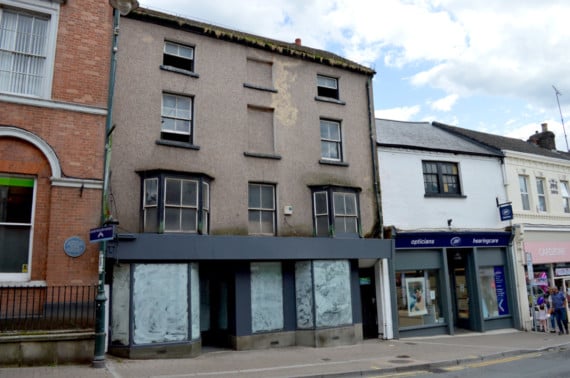
Three groups dedicated to preserving the heritage of Monmouth town have approached the county council to express concerns over a high street property.
The civic society, archaeological society and the 2020 vision group have fears that history may repeat itself with No 20 Monnow Street having comparisons to the 1986 demolition of a listed building without consent and the associated destruction of archaeology of national importance.
Although the owner has complied with council officers and taken off the shuttering that hid the decayed facade of the building, fears and rumours concern the integrity of the building and the three groups have written a combined letter to the Beacon (see page 15) declaring their priority is to preserve the building and the archaeology beneath it.
They issued a joint statement saying: “We are concerned that, as we understand it, the county council has not so far over the last three years requested the owner to carry out even basic work to make the building weather tight. Simply clearing the rainwater goods and closing the windows are obvious low-cost steps. (See letters Page 16).
.jpeg?width=209&height=140&crop=209:145,smart&quality=75)


It’s neighbouring property, the former Taylor and Jones, was the scene of an extensive archaeological dig in the 1990s after the premises was considered to be in an important position in the town.
That was where a large wooden structure had been demolished by the Normans so they could have a clear area in front of the upper town defences.
No 20, for a long time Mr Badham’s the jewellers, was where archaeologists Phil and Richard Grindle found a ditch which has probably been back-filled by the Romans with conveniently dateable pottery of pre-Flavian date and it was this discovery that confirmed Monmouth’s place in the first Roman invasion of Wales as a fort as early as the fortress at Usk (Down the Dig - Monmouth, an Adventure in Archaeology by Stephen Clarke).
Of even greater concern to the three groups is that the disaster that befell the listed Kwik Save building in 1986 (nowM&Co) would not be repeated at No 20.
In March this year, the Beacon reported that town council planning committee members were told that the owners of the building were unsure whether it was viable to repair the premises.
After speaking to county heritage manager Amy Longford the chair of planning at that time said that the owners “have no idea of the extent of the damage but in places it is very unstable and they do not know whether it is economically viable to repair and mend. They don’t even know if it can be mended and brought back to a safe state.”
Archaeologists also feared the worst after communications from county council planners hinted that they may accede to a request to demolish the property.
Any proposal to do so would be subject to an application for listed building consent, which did not happen in 1986.
A local builder fuelled fears over the repairs to the front of the building as he told the Beacon that the temporary facade was made from material which would not stand up to inclement weather.
The town council became so concerned over the deterioration of the property that it spurred them on to write to all landlords of premises that were in a state of disrepair asking them to pay attention to the frontages of the premises and were instrumental in getting the boarding off the front and an acceptable appearance restored to the upper part of Monnow Street.
Find out about planning applications that affect you by visiting the Public Notice Portal.
•Monmouth Town Council has referred four buildings to the county enforcement team after the landlords had failed to respond to their requests to keep them in good condition. The premises they believed need attention by the landlords are DS Music at the top of Monnow Street, Phil Munday’s shop in Church Street, 4 Priory Street and the Vine Tree, although they noted that the last premises had seen some work done to address the deteriorating lower windows.
Comments
This article has no comments yet. Be the first to leave a comment.