
I am always thinking of ‘better’ ways to grow veg at home, and have had a huge variation in success over the last ten or fifteen years. It’s definitely getting harder though. The area I decided to develop and use at the cottage years ago, is south facing, on a steep slope and full of ground elder. It dries out really quickly (hard to imagine right now) and the ground elder is quite frankly a ‘bloody nuisance’. I also have to ‘share’ the plot with rabbits, mice, moles, voles and pigeons – oh and now my free-ranging-further hens.
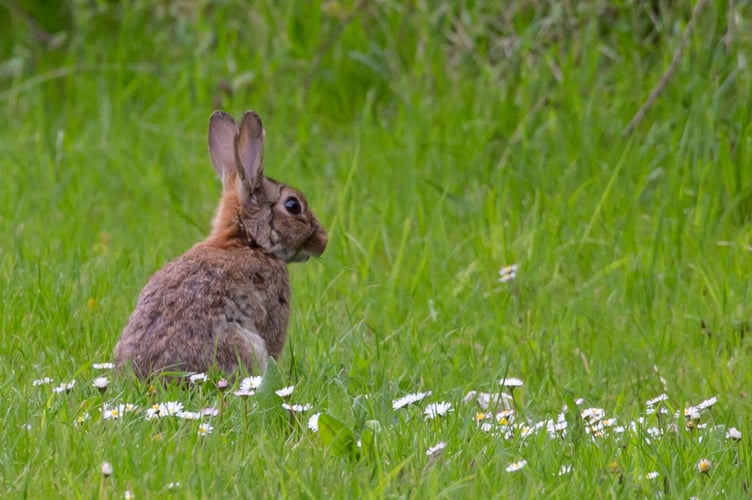
Rabbits were the biggest problem last year. It was like Watership Down here, but I like seeing them bounce about so had to try and work with them. I failed. Rabbits and hot, dry weather won handsomely.

This year I suspect the former won’t be a problem as we have had a severe outbreak of myxomatosis. It has to be the cruellest of diseases and yes, of course – man made. The last couple of months have not only been agony for my ‘local’ rabbits but also for me, as I have found diseased and dying rabbits several times a week, either in my garden or in the adjacent lane. One morning I opened my front door to find one alive but motionless on the mat. It was as though he was there for help, and it just breaks my heart. Although it would be the kindest thing to do, I can’t dispatch them. I have to rely on a neighbour and when Wendy’s not around I have been known to contact Phil from P & P Pest Control. It’s not my favourite thing to be writing about but he is just brilliant, ‘old school’, and is good with me too.
He is also a fountain of knowledge about all things ‘countryside’ and explained the myxomatosis cycle to me.
It originated in Australia as a method of controlling an exploding rabbit population. It was introduced to the UK for the same reason. It is carried by a flea which is immune to the disease, and which lays eggs in the warmth of a nest inside a burrow. These eggs hatch, the fleas hitch a ride on the rabbits and get spread by what rabbits are famous for. The eggs can stay dormant in a nest for years – until a rabbit moves in to have its young and then the cycle starts all over again. This explains the sporadic outbreak of myxomatosis when the rabbit population increases. As the rabbits multiply, they are more likely to use a contaminated nest and then go on to spread the infected fleas as they re-produce, sparking an ‘outbreak of myxomatosis.’
It is a savage way to die. I’ll spare you the details – if you know you know. If you don’t, let’s keep it that way. Phil was also explaining that there is a new rabbit-restricting disease on the block, supposedly introduced as there are no visible symptoms, making it less stressful for humans – which, unfortunately can’t be said for the rabbits.
The new disease, called Rabbit Haemorrhagic Disease (RHD), is a highly infectious and lethal form of viral hepatitis, with some viral strains also affecting hares. Most diseased or dead wild rabbits are never seen, as they die suddenly in their burrows.
Although the newer viral strain RHDV2 was first detected in Britain in 2014, it’s spread through wild rabbit population is thought to be increasing rapidly. Described as ‘more lethal than myxamotosis’, and with mortality rates generally range from 70 to 100 percent, it’s not looking good for our wild rabbits.
Comments
This article has no comments yet. Be the first to leave a comment.