
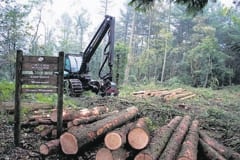
OVER 200 hectares of diseased larch have been cut down this week in Wentwood Forest.
Despite the destruction, it is expected that the sudden oak death will continue to spread, requiring further felling in coming months and years.
Phytophthora Ramorum, also known as sudden oak death, was found in the trees of Wentwood Forest meaning that seven years of work by the Woodland Trust in the forest will be undermined and the delicate restoration work the charity began in 2006, involving the gradual removal of conifers to allow native broadleaf trees and characteristic ancient woodland flora and fauna to return, will be destroyed.
Andrew Sharkey, Head of Woodland Management at Woodland Trust, said: "This is the most serious and devastating action we've had to take on our estate due to tree disease and it again highlights both the need to tackle tree disease and the importance of restoring as much of our damaged ancient woodland as possible to make it more resilient in decades to come.


"Restoration will allow native trees to establish themselves over a long period of time. Creating a resilient woodland landscape with different species of trees of different ages is the most effective natural weapon to ensure tree disease does not decimate the countryside."
Following the felling, the Trust will immediately replant the wood with native broadleaf trees such as oak and cherry, in the hope of preserving woodland specialist plants that only thrive when sheltered by tree canopy. As no restocking grants are available in Wales this year, it leaves the Trust facing a bill of £35,000, unlike in England where grants are available.
John Browne from Natural Resources Wales said: "The felling in Wentwood Forest is very sad but this prompt action by the Woodland Trust is essential to try to slow the spread of this devastating disease.
"Natural Resources Wales is investing £500,000 immediately to try to stop the disease from spreading further, with an additional £2 million being set aside for future work. Our ultimate aim is to make our forests more resilient to pests and diseases and we are heartened that the Woodland Trust is to seize this opportunity to undertake change of structure and species within Wentwood Forest by planting native broadleaves."
Natural Resources Wales is also planning a series of Phytophthora Ramorum drop-in sessions to offer advice on what to look out for and how to report any suspicions.
More information on the sessions will be advertised locally and will be posted on the Natural Resources Wales website.
Comments
This article has no comments yet. Be the first to leave a comment.