

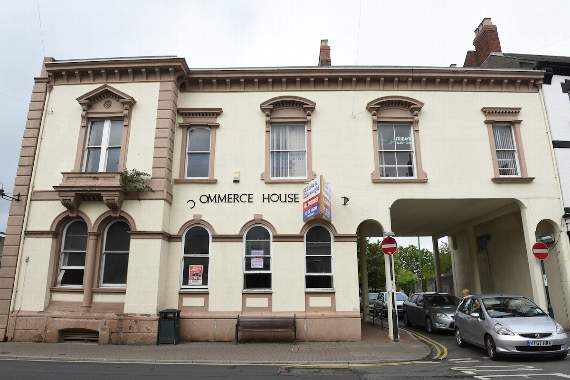
Monmouthshire County Council (MCC) officers involved in the Commerce House development, have issued an ‘unreserved apology’ to Councillor Stuart Wilson, chair of the town’s planning committee following the failure by the planning authority to protect the archaeology under the floors of the former Red and White Services building.
Mark Hand, Head of Planning for MCC and Planning Officer Craig O’Conner admitted they failed to consider “the impact of the ground disturbing works on the archaeological resource” when assessing the non-material amendment to the 2012 consent for change of use to Commerce House.
Architect Graham Frecknall’s 2012 Design and Access Statement in the original application (DC/2012/00456) said: “After initial discussions with Monmouth Archaeology we understand that due to the minimal below ground works proposed, an archaeological report is not required” and concluded, “the proposals presented by this application ensure minimal impact on site archaeology”.
However a later 2015 application (DC/2015/00134) sought permission for “internal amendments including reduced floor level of part of the building” a material amendment in a non-material application, which is not allowed and was recommended by Craig O’Conner as suitable for this type of application at the end of January 2015 and approved by the same officer the following month.




Cllr Wilson, in his letter to Mark Hand stated: “The application to lower a floor in a conservation area, an area of archaeological sensitivity is a material change to any application and in no way could be considered to be justified as a non-material application.”
He continued: “That the Local Planning Authority (LPA) allowed a material change in a non-material application is an abuse of its power by bypassing normal consultations with specialists and its failure to apply archaeological conditions has violated both local and national policy.”
In reply Mark Hand said: “I can confirm that you are right and that the error occurred with application DC/2015/00134. Unfortunately we assessed that request solely in the light of the physical changes to the building that were proposed, which were concluded to be a non-material amendment. However, what we failed to consider was the impact of the ground disturbing works on the archaeological resource.”
Following the incident, as reported in the Beacon last week (12th August), Paul Matthews, MCC’s Chief Executive, and Mark Hand met with Stephen Clarke and colleagues on site Wednesday 12th August and afforded Monmouth Archaeology full access.
Comments
This article has no comments yet. Be the first to leave a comment.