

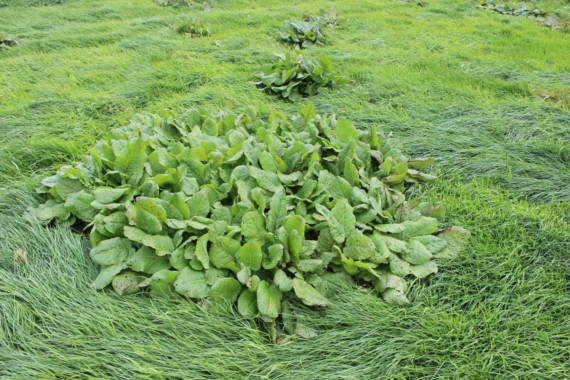
Docks are one of the most economically damaging weeds in grassland, competing directly with grass and reducing yield, farmers were advised during a Farming Connect event.Â
Docks germinate mostly in the spring and autumn but at other times too, from both seed and roots; each plant capable of producing 60,000 seeds a year, seeds that can be viable for 80 years.Â
Docks do have some feed value - 65 per cent of the feed value of grass - but stock won’t graze the plants when they are mature.
Topping is generally ineffective as plants recover and set viable seeds but a range of chemical controls are available.Â




A field treated with a product containing Fluroxypyr and Tricloypyr at half-rate early in May led to the control of over 95 per cent of docks.Â
Another field was treated with full rate Amidosulfuron, a clover-safe product. There was dock regrowth in more than half the ley and flowering at the base of the stunted docks.
It is recommended to apply on an actively growing dock at about 20cm diameter.
Applying a herbicide at the reseeding stage is also important as they work more effectively on docks at the seedling stage. Also, selecting a product which controls docks down to their roots - known as translocation - gives better long-term control.
Comments
This article has no comments yet. Be the first to leave a comment.