
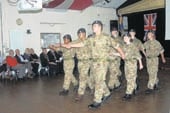
Chepstow commemorated the anniversary of Britain's entry into the First World War this week. The town's mayor Ned Hayward led a moving commemoration service on the 100th anniversary of the departure of E Company of the Monmouthshire Regiment on Tuesday (5th August). The regiment, who headed for the Western Front on 5th August 1914, set out from Chepstow Drill Hall for Pembroke Dock. E Company, 1st Battalion Monmouthshire Regiment eventually fought from 22nd April to 25th May 1915 in the second Battle of Ypres. The main attack took place on 8th May, when the Monmouthshire regiment suffered huge losses. The date, 8th May 1915 appears more times on the Chepstow war memorial than any other date in the Great War. The Bugles of the 1st Rifles provided a bugle fanfare, followed by Beachley Army Cadet Force showing off their drill technique. Padre Andy Latifa, Chaplain of 1 Rifles, then took the service, during which there was a two-minute silence to honour the fallen. The service was attended by representatives from the Army and Sea Cadet force, serving officers of 1 Rifles, town representatives and local service providers. A Lights Out service was held the previous evening as RBL chairman Ken Davies led a service at St Mary's church at 9pm. Attending the service and assisting Mr Davies with the readings by candlelight were members of the RBL and the Town Mayor Cllr Ned Heywood MBE with Deputy Town Mayor Cllr Dale Rooke. In Monmouth, military personnel, MPs, members of the town council and members of the public gathered at the castle's cenotaph at 10pm to mark the moment that Great Britain declared war on Germany. Candles were lit at Monmouth Castle and St James' Square cenotaphs and as part of the Royal British Legion's (RBL) Lights Out campaign in which households across the UK were encouraged to turn lights off in favour of candles between the hours of 10pm and 11pm. Chairman of Monmouth RBL, Councillor Gerry Bright, and Padre Leigh Richardson from The Royal Monmouthshire Royal Engineers (Militia), led the service which saw those present reflecting in prayer for the dead with poetry, hymns and both the Welsh and British national anthems. A minute's silence marked the moment that Britain joined a war that would go on to kill around 16 million people, 40,000 of them Welsh soldiers. The inspiration for the RBL Lights Out campaign came from a famous remark made on the eve of the outbreak of war by the then Foreign Secretary, Sir Edward Grey. He said: "The lamps are going out all over Europe; we shall not see them lit again in our life-time." The official statement from that time was recorded in the Beacon, printed on 7th August, 1914. It said: "Owing to the summary rejection by the German Government of the request made by His Majesty's Government that the neutrality of Belgium would be respected, His Majesty's ambassador in Berlin has received his passport, and His Majesty's Government has declared to the German Government that a state of war now exists between Great Britain and Germany as from 11pm on August 4th." Monmouth's service welcomed several local residents, among them 91-year-old Ron Roberts, who served his military career with the Royal Air Force. Mr Roberts wore both his own medals, and those of his half brother William Roberts, after the latter became one of the first Monmothians to be killed during the war, aged 18. "At 1am on 14th August, he was given the orders to find out whether the Germans or the Belgians held the bridge over the local canal," said Ron. "Someone had the idea that if they galloped up to the bridge and they were fired upon, they were probably German. He was shot and killed in this exercise, and has no known grave." The troops of The Royal Monmouthshire Royal Engineers (Militia) left for battle as soon as the King's announcement was made. Cllr Bright said on Monday: "The very best of the town and county's young men boarded the train, many never to return to live in the beauty of our county." The Beacon reported at the time: "On Tuesday the Royal proclamation embodying the Territorial Force caused intense excitement, and the men had to report themselves at once. "On Wednesday the men assembled at the Drill Hall, and soon after 5pm, headed by the band of the RMRE (SR) marched to Troy Station where they were given a hearty send off. "The men were in full marching order, and each carried 10 rounds of ball cartridge. "Farewells were said and as the train left the station, the band played 'Auld Lang Syne', to the accompaniment of vociferous cheering."
Chepstow remembers First World War heroes
Tuesday 5th August 2014 11:00 pm



.jpeg?width=209&height=140&crop=209:145,smart&quality=75)
Comments
This article has no comments yet. Be the first to leave a comment.