

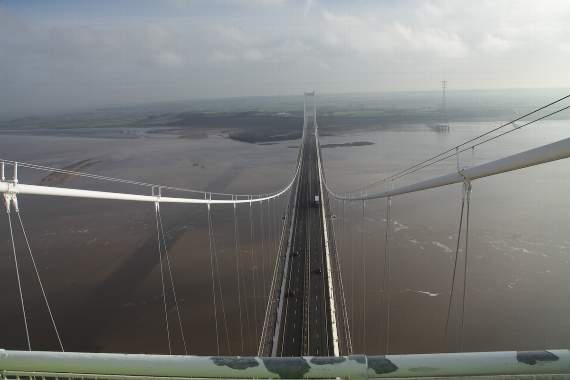
A SERIES of events to celebrate the 50th anniversary of the Severn Bridge have been planned this month.
To mark the 50th anniversary of the bridge that linked Wales and the West of England, BBC documentary ‘The Severn Bridge at 50: A High Wire Act’ will be showing tonight (7th September) at 7.30pm on BBC One Wales and BBC One West on Friday 9th September at 7.30pm.
The documentary goes behind the scenes to meet the ‘family’ of specialists in-house engineering and maintenance teams who look after the iconic bridge.
The one-off documentary mixes the present day story with the high wire tale of its epic construction. With contributions from site engineers like John Evans, who worked on the foundations of the Beachley Tower and Anchorage and who now lives near Magor, and Michael Parsons, who drew up the original specification for the bridge after graduating from Bristol University in the late 1940s and who now lives in Sidmouth.


The story of the bridge’s revolutionary design and construction is told through the words of individuals with first-hand experience of the build, interwoven with archive film.
Mr Parsons and colleagues at renowned bridge engineers Freeman Fox and Partners pioneered a light weight and aerodynamic road deck. With its internal stiffening, their design did away with the need for criss-crossed supporting trusses under the road - like on the first Forth Road Bridge and the traditional American suspension bridges - and in the process transformed long span bridge design.
Five decades on, the elegant box girder design of the Severn Bridge is industry standard worldwide - and the Bosphorus, Humber and Yangtze Bridges (amongst many others) are all design descendants of ‘our’ bridge.
“The Severn Bridge is remarkable,” said John Evans, “I don’t say was, it is remarkable still.”
Typical of the era though, little thought was given to how this revolutionary structure would be maintained.
The film’s director Robin Toyne said: “What fascinates me, is that to maintain the bridge every inch of its surface has to be in touching distance.
“So, in many ways, the inspectors, engineers and maintenance teams of today have to be just as ingenious as the original designers to reach every nook and rivet in order to keep the bridge up to scratch.”
Meanwhile, a leaflet by Chepstow Town Council is to be published to document the landmark’s history.
The bridge, which was opened by the Queen 50 years ago tomorrow (8th September), is world famous and iconic in its design.
The leaflet for residents and visitors to the town explains why the bridge is so special for the world as well as to Chepstow. The Severn Bridge was the first major bridge to have a thin aerodynamic road deck, and since being built, 90 per cent of the world’s longest suspension bridges have followed this example. The pioneering aerodynamic deck was first assembled at Chepstow and floated down the Wye to the bridge site.
After 50 years the Severn Bridge continues be an elegant and iconic structure, which impresses those who use it or those who simply gaze at the beauty of this mile long landmark.
Town Mayor, Councillor Paul Pavia, said: “The Severn Bridge is a world famous bridge and can be seen from all parts of Chepstow where its pioneering road deck was assembled. We celebrate 50 years of this iconic, graceful and vital link between Wales and England across the Severn and the Wye.”
The leaflet was written and researched by John Burrows who also authored the information leaflet on Chepstow Bridge which was 200 years old this year. It contains notes from the official brochure issued by the Government and Gloucestershire County Council at the opening of the Severn Bridge in 1966.
The Institution of Civil Engineers for South West England are organising a procession of old cars across the bridge on the 8th September 2016 and a reception for engineers involved in the bridge at the Old Ferry Inn.
Comments
This article has no comments yet. Be the first to leave a comment.