
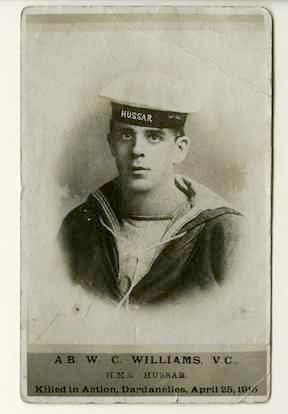
THIS Saturday (25th April) marks the 100th anniversary of the Gallipoli Landings, and will commemorate the hundreds of thousands who lost their lives.
It was on that fateful day in 1915 that Able Seaman William Charles Williams' heroic action won him the Victoria Cross but also lost him his life.
He holds a special place in Chepstow's heart and is honoured by two public memorials, the German U boat gun in Beaufort Square presented to the town by King George V, and a painting showing the Landing which hangs in St Mary's Priory and Parish Church, as well as a display in Chepstow Museum which shows more of his story.
Every year a service is held at 11am on Anzac Day when wreaths are laid on the Memorial Gun.




This year, at the centenary, the special commemoration will include a parade down the closed high street before a memorial service at the gun beside the cenotaph in Beaufort Square. Members of the Williams family from Chepstow and beyond will join in the laying of wreaths.
William Charles Williams was born on the 15th September 1880 not in Chepstow but at Stanton Lacy, Shropshire where he is also commemorated, but Chepstow became the family home. William Williams worked as a gardener at the nursery in Station Road and the family lived in Upper Nelson Street.
The young William worked as a labourer before he joined the Royal Navy as a Boy at Portsmouth in December 1895. On his 18th birthday he signed for a further 12 years service and in 1899-1900 was recommended for bravery as a member of HMS Terrible's Naval Brigade during the Boer War and in China during the Boxer Rising.
Completing his regular service with the Royal Navy in 1910, he joined the Royal Fleet Reserve and returned to Monmouthshire to work at Lysaght's Orb Steel Works in Newport. In 1912 he joined the county police force and after postings at St Mellons and New Tredegar resigned just over a year later.
At the outbreak of war he was recalled to active service joining HMS Hussar in September 1914, which came under the command of Edwin Unwin in February 1915. Preparations were in progress for the ill fated Gallipoli campaign and the landings at V Beach were expected to meet fierce opposition.
Large numbers of troops needed to be landed quickly. The plan was that strings of open boats of men would be towed to the shore by trawlers but these could only take 300 men at a time, not nearly enough to secure success in the first vital hour. It was Unwin's idea that a specially prepared ship might be rammed ashore from which 2,000 infantry would pour from a series of doors cut into her sides, then dash along specially rigged gangways to the prow. From there a flat bottomed steam barge would be positioned to form a bridge for the troops to reach the shallows. As a precaution some extra lighters or barges, specially decked, would be towed along to fill any gaps in the bridge to the shore. The ship once beached would also support the assault with machine guns and carry supplies.
The SS River Clyde, a 10-year-old coal carrying ship, was converted into this 'Trojan Horse' troop ship. Unwin, promoted to the rank of acting Captain, had responsibility for carrying out his own plan and took with him 15 volunteers from his ship HMS Hussar including Williams.
On 25th April as the first wave of towed boats were within a few yards of the shore, the Turkish defenders lashed the open boats with machine gun fire with devastating results. The beaching of the River Clyde did not go to plan. The ship ran ashore further away from the beach than intended and the steam barge had grounded alongside the ship so couldn't be got into position to form the bridge as planned. It was now down to using the unwieldy lighters which had been brought along as a back-up to fill gaps, to form the floating bridge.
Unwin and Williams manoeuvred these barges into position and wading through the water hauled the front boat as close as they could to a spit of rocks that ran to the shore. But the rope was too short to tie so they took the strain and chest-deep in the sea, held the floating bridge in place while Midshipman Drewry went to get another length from the ship. The men could now leave the SS River Clyde and attempt to reach the shore across the bridge under fierce fire from the Turkish guns. Many were mown down. They were easy targets as they made their way down the gangways on the side of the ship, they fell into the sea, and the bodies of dead and wounded men quickly became obstacles that men behind had to clamber or crawl across as they tried to reach the shore. Dead and wounded fell into the water and were drowned.
Unwin recalled that he and Williams were "literally standing in blood". All the time machine gun fire rained down around them and after an hour Williams was hit by a shell. Unwin caught hold of him and Williams died in his arms.
Able Seaman William Charles Williams was the first ever naval posthumous award of the Victoria Cross. His citation reads: "Held on to a line in the water for over an hour under heavy fire, until killed."
His father received the VC from King George V at Buckingham Palace in 1916. The VC and Williams' other medals left the family many years ago, but in 1997 they came up for auction and Chepstow Museum raised nearly £50,000 of grant aid to secure them, but Lord Ashcroft's pockets were deeper and they are part of his large collection of VCs, now shown in rotation at the Imperial War Museum in London.
Williams was one of six men of the Royal Navy all serving on the River Clyde, to receive the highest award for gallantry that day for maintaining the floating bridge and rescuing the wounded. By 9am, when the action was temporarily halted, after just two and half hours, more than 1,000 men had been killed or wounded attempting to disembark.
On January 8th 1922 three war memorials were unveiled in Chepstow. As well as the cenotaph, the gun was unveiled by Mrs Frances Smith, Williams' eldest sister, and Capt Unwin VC unveiled the painting of the landing of the SS River Clyde by Charles Dixon in the Church in honour of: "the bravest sailor he ever met the man above all others who deserved the VC at the landing".
Trevor Williams, nephew of William Williams, lives in Rogiet and commemorates Anzac Day every year in Chepstow.
He said: "We have a very big family so we all get together and go to the memorial service in the town.
"It is a great way to remember William Williams. I have a six year old grandson and I hope one day to tell him about the landings.
"It happened a long time ago but I am very proud of what he did."
After the memorial service on Saturday, the family will attend a celebratory event in the town hall.
Chepstow Museum is holding an exhibition to commemorate the centenary and is open Monday to Saturday from 11am to 5pm and Sunday from 2pm to 5pm.
Pictures courtesy of Chepstow
Museum.
Comments
This article has no comments yet. Be the first to leave a comment.